

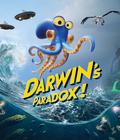







At the tail end of the Xbox 360/PS3 era, before Konami would shift its focus away from the gaming space, the Japanese company focused on publishing both big and small games from Western developers. Games like Tornado Outbreak, Zombie Apocalypse, and NeverDead came out, and while the successes were moderate, it was still good that the company dabbled in this sort of thing while its own developed releases were slow in coming out. After Konami's return to the video game space, the company has returned to this strategy of Western releases to fill in the gaps from its own developed titles and remasters and compilations. We saw this before with the likes of SkelAttack, Cygni: All Guns Blazing, and Deliver At All Costs, and the company is continuing this practice with its latest title, Darwin's Paradox, which is the debut game from ZDT Studio.
You play the role of a small octopus named Darwin who's happy to live his life in the wide blue ocean with his friend. One day, both of them get kidnapped by aliens and put in a jar with other captured octopi. Darwin is about to be butchered, but somehow, he's thrown into a barrel instead; he frees himself in a landfill just outside of the nearby Ufood factory. Instead of immediately returning to the ocean, Darwin tries to break into the factory to free his friend and potentially other kidnapped sea life.
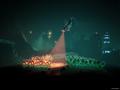
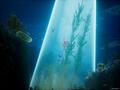
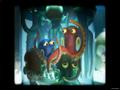
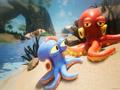
Darwin's Paradox is mostly a 2D puzzle platformer similar to Limbo or Planet of Lana. That means a whole lot of moving and jumping to get from point A to point B in interesting-looking locales. It helps that the platforming feels precise without the game becoming a precision platformer, and it never feels like the game hampers your movement and jumping. It also helps that the game sports no fall damage except when it's completely obvious that you're reaching terminal velocity.
Puzzle-solving isn't of brain-teasing caliber, but you will encounter moments when you need to hit switches and time your movements before the switch resets or figure out how to avoid obstacles that will instantly kill you. There's never a moment when you don't know what the solution is, and even if you mess up, the load times are quick enough that death doesn't feel punishing.
Like many games of this type, there are sections where you need to employ stealth, and much like the puzzle sections, these parts aren't too punishing. You will die in one hit if you get caught, and the enemies are quick enough that being seen and chased after means instant death. The game gives you some leeway in terms of doing things before enemies go into a full red alert status, and some sections merely set you back in progress when caught instead of outright killing you. You'll also be glad that checkpoints are numerous. There's no fighting, since you possess no offensive maneuvers. That kind of base is good enough to make for a decent experience, but there are several elements that give this game an identity of its own.
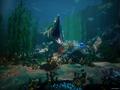
For one thing, there's a division between land and water levels. The sentiment about control accuracy refers to the majority of the game when you're spending your time on land, but that sentiment also applies to the parts where you need to navigate the water. There's a level of precision when swimming that you don't get in most games, and navigating through liquid feels effortless. Things like navigating through a mine field don't become treacherous, since you won't find yourself suddenly drifting into those hazards unless you're doing so on purpose. That's a good thing not just because awkward swimming wouldn't fit the actions of an octopus, but because the game throws a large chunk of water sections at you and for decent stretches.



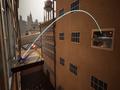
The next element at play is traversal with your suction cup tentacles. A decent part of the game has you walking on walls and ceilings at various angles. This is always a fun thing to do in games, but what makes it more enjoyable is the fact that the controls feel intuitive. It never feels like a struggle to move, as the commands don't change when transitioning from wall to ceiling and back again. Jumping between walls is also fluid, and everything feels as good as it does when you're traversing water or flat land.
The ability to use active camouflage is the next element of Darwin's Paradox that gets a good amount of use once you reach the sections with stealth. It activates by holding down a button, and the effect is cool to look at, since you take on the properties of the surface you're on, whether that's flat land or you're sticking on a surface. It looks nice when you're trying to disguise yourself as a rock, but it's much neater when trying to look like a brick or crate as you take on the various colors on display. The ability isn't fool-proof, as you can't use it while moving and people can still see you transform in front of them, but it is a neat little trick nonetheless.
Your last major ability, shooting ink, becomes a multi-purpose tool once you unlock it. When in the water, it's a stealth tool, since you can use it to camouflage your movement. On the ground, the ink can activate some switches and take down cameras, but it does nothing for people. However, you can use it to distract others, since it's strong enough to knock down cans. It's fun to use, and the only lament with this and your camouflage technique is that you don't get to use them early on, even though you learn about them at the very beginning before the adventure even begins.
Everything comes together to create an experience that feels breezy in a good way. It has been said before, but it bears repeating that nothing feels overly difficult. There are some challenges, and you will die quite a bit, but that occurs because of experimentation and guessing badly about what's ahead, rather than poor controls or the inability to read the environment quickly. The puzzles are easy to solve, and the game gives you a good hint system that nudges you about what to do without spelling it out. Only the most obvious of obstacles will kill you outright, and some enemies and hazards let you take a few hits before you expire. Overall, the balance and pacing are just right.

While the game is mostly "one and done," completionists will want to go through again to find all of the collectible newspaper clippings and ads strewn about the game. There are 20 of them, and the game places these things in areas that are just off the beaten path to reward those who are willing to look around. They mostly provide more lore for the game, which is more useful because Darwin's Paradox heavily relies on visuals to tell the story. The collectibles provide a bit of an incentive for completionists.
The audio is excellent. The game lacks any voices except for the opening commercial, so it falls on the sound effects to carry the story, and they do a great job of making the world feel rich. Everything from the sound of tentacles splattering on the mud to the incoherent grumbling of the robot workers and the ambient chirping of seagulls and rats do well in filling the soundscape. The soundtrack is a nice blend of adventurous and mysterious with a little bit of whimsy for some key spots, and it all sounds wonderful whenever it plays.
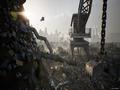
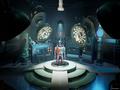
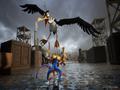
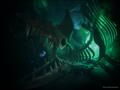
Graphically, the game looks gorgeous. The destruction tries to emphasize how the team was going for a premium animated look, and it comes through when the colors and filters make the game look like a decently budgeted movie. The character designs go for a softer design than normal, and the animations are absolutely smooth. The game runs at a high frame rate if you have powerful hardware for it, but it doesn't look out of place when played against the cut scenes, which move at 30fps. The environments are the real showcase. Some places demonstrate a good use of lighting and shadow, while others show off how busy a place can get with lots of moving pieces that don't show stuttered animations or bad texturing. Examples include a factory with boxes moving along conveyor belts and an office with lots of workers milling around. The outside of the factory on a rainy night looks beautiful in motion and in still shots. This is a real looker of a game.


Despite the use of Unreal Engine 5, Darwin's Paradox runs pretty well on the Steam Deck. Part of that can be attributed to a toggle in the graphical settings specifically made for Steam Deck, so everything is automatically tuned for the system in one go. The result is a game that still looks great with only a little bit of blur in the busiest of areas. The frame rate caps at 30fps, but transitioning into newer areas produces a brief frame rate drop that can go as low as 9fps before the game returns to 30fps. The game's resolution is at 1280x800, but the battery life takes a big hit; you come away with roughly 90 minutes of gametime on a full charge on the Steam Deck LCD version. Meanwhile, those looking to play the game on a Linux system will find that it works just as fine there as on Windows, with no additional tweaking necessary. The only exception is if you're using a distro that emulates the Steam Deck, in which case you'll need to enter a Steam Deck launch argument when launching the game to open the graphical options.
Darwin's Paradox is an enjoyable puzzle platformer from start to finish. The platforming feels good, while the puzzle aspects aren't overwhelming to the point that it detracts from the journey. The octopus abilities are well implemented and don't feel difficult to use, and the overall journey feels like it moves along at a good clip without meandering for too long. With a gorgeous presentation in place, there's little to gripe about, and fans of puzzle platforming who value experience over challenge will love Darwin's Paradox.
Score: 9.0/10
More articles about Darwin's Paradox!