

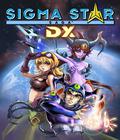






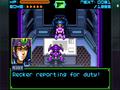
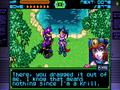
Sigma Star Saga DX is set in the distant future. After a brutal attack by aliens known as the Krill, humanity has developed advanced fighter ships. A second attack catches humanity off guard, and one of the only survivors of the attack is ace pilot Ian Recker. Due to his talent, Ian receives a difficult mission: pretend to defect to the Krill, so he can gather information on a deadly superweapon that threatens all of humanity. Once Ian joins the Krill, he quickly learns that things aren't quite as straightforward as they seemed, and there may be more going on than a simple intergalactic war.
Sigma Star Saga DX's plot is simple but enjoyable. The characters are basic stereotypes, and the plot is predictable, but it does its job well enough, and there are some genuinely likable things. One of the make-or-break elements of the game is the love triangle between Ian, a human scientist named Scarlet, and his Krill rival-slash-coworker Psyme. It's a by-the-numbers triangle, but multiple endings encourage players to pick their favorite outcomes, and the plot has some twists.
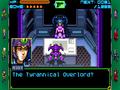
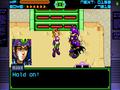

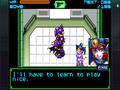
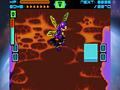
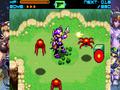
The bulk of your time in the game is spent wandering around various dungeon-like planets as Ian. The planets are somewhat akin to a Zelda dungeon, made up of interconnected rooms to explore and minor puzzles to solve in order to reach the end and fight a boss. You'll gather various items as you explore, such as a scanner that allows you to find hidden objects or wings that let you fly over gaps in the ground. The actual linear paths through the stages are pretty clear, but there are hidden secrets and even the ability to return to earlier levels to collect power-ups you couldn't reach before.
Largely, the dungeon exploration is fun but very by formulaic. There's very little in the way of twists and surprises, and a good chunk of the puzzles end up being "key" puzzles, where the solution is to have the correct item. There's enough engaging stuff to keep the game fun to play, but it does feel rather basic. It's understandable given the game's handheld roots, but I would've loved to see some more flexibility in item usage.
Combat is largely optional. There are times you need to fight, but fighting is mostly about getting stuff out of your way. Most of your fighting is done with a handgun that you carry at all times, and it does the job of clearing out foes. However, it means a lot of combat involves kiting enemies and occasionally shooting them. The game is very clear that this isn't necessary, and it even stresses that you don't get stronger by fighting on foot. That's all reserved for the game's random fights.
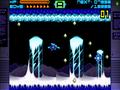
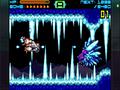
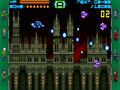
Rather than standard RPG battles, the combat encounters in Sigma Star Saga take the form of side-scrolling shooter segments. You're warped into one of the Krill's spaceships and must go through a basic side-scrolling segment. There are a variety of ships, ranging from small fighters to giant bulky transport ships, but they are randomly chosen and vary primarily based on their default shot, which usually takes the form of a simple blast or bombs. You also have access to limited smart bombs that you can find in the overworld.
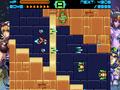
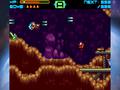

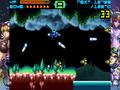
The default shot isn't your primary method of fighting. As you progress through the game, you'll collect gun data in the overworld maps. These pieces of data come in three types: firing type, bullet type and bullet impact type. For example, your default weapon fires straight head in a single burst and has no impact ("absorb") when it hits an enemy. As you find this data, you can customize a weapon to fire three shots instead of only one, aim in the direction your ship is moving, and create explosions where it hits. You can also customize missiles to fly out of both sides of your ship and make bubbles float up where they hit.
The gun data system is pretty neat, but it's not that meaningful in the long run. Yes, there are over 10,000 different options, but the majority of them are niche enough that there's little reason to use them, especially since you're limited to using either your customized shot or a weak (and frequently worthless) default shot that varies from ship to ship. Sure, I can set up my ship to fire in a rotating circle, but why would I want it to? Even making the ship's weapons fire at an angle is frequently more trouble than it's worth. Once I found something that was reliable, I never swapped unless I got something that specifically enhanced it. There appear to have been some minor changes to weapon balance, but a lot of things still felt too limited.
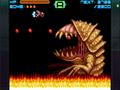
In Sigma Star Saga DX, your goal in most of these battles is to defeat a specific number of enemies to end the fight. Some fights only have a single strong character, while others may have a few weaker enemies but complex environments. Some are no-frills shoot-'em-ups. Every so often, you'll get a significantly longer stage that feels more like a standard shoot-'em-up stage with a significantly longer time, no enemy limit, and a big boss at the end, but those usually punctuate the end of specific segments rather than appear in random battles.
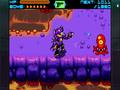
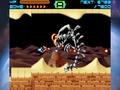

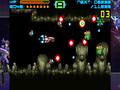
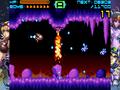
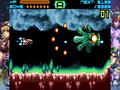
Truthfully, I don't think the random battles work that well. It's rare for them to be challenging enough to pressure you, and since you're given little reason to customize your weapon, you're going to use the same basic setup for everything. They're fun enough for a short while, but to some degree, they feel like game padding. The more custom-designed levels tend to feel better. The random encounter rate in the original version of the game was awful, and thankfully, the remaster improves upon it somewhat, but there were still times when I was tired of being pulled away mid-puzzle. The reduced random encounter rate is also paired with increased experience gain, which is a nice bonus.
In a lot of ways, Sigma Star Saga DX feels more like what you might've gotten if GBA games had received patches. There are a lot of small changes, and every single one of them is for the best. To name a few of the changes, some dialogue has been rewritten, the maps are more reliable in showing important locations, you can auto-fire without button-mashing, and there are the aforementioned balance changes and reduced encounter rate. Beyond a few minor things, like a save feature you can use anywhere and a built-in rewind feature, there aren't any significant changes to the game that I perceived. There's also a built-in sound test and concept art gallery.
This isn't necessarily a bad thing, but it might make the game seem costly if you're not already a fan. The graphics are blown-up pixel art, which I prefer, but it might be a little disappointing if you're playing on a big screen. The game shows its GBA roots with big chunky sprites and minimal character animation, but it did look quite good for a GBA game. The soundtrack is solid enough but not one of my favorites from Wayforward, although there are enough good songs to keep me interested.
Sigma Star Saga DX is an interesting revival of a cool but flawed game. There's a lot I like in concept rather than in execution, but neither is it particularly bad. The combat and puzzle exploration can get a little long in the tooth by the time you reach the end of the game, but it's fun enough to be a worthwhile playthrough. It's a perfectly solid re-release that alleviates — but doesn't necessarily fix — the original version's worst flaws. If you're curious, it's well worth a shot, and if nothing else, it's a very cool experiment from a long-lived developer.
Score: 7.0/10
More articles about Sigma Star Saga DX