


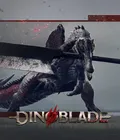
 Dinoblade is an intense action/RPG set in a prehistoric world forever changed by a cataclysmic event. Step into the role of a young Spinosaurus, wielding a colossal Great Sword.
The Souls-like genre has featured a variety of protagonists in its relatively short lifetime, from knights and samurai to puppets, hunters, foreign travelers, the Tarnished, and even crabs. It has also explored an equally diverse set of locales, where parrying and brutal hits are the norm for combat. The subgenre's relative youth demonstrates that there are still a good number of protagonist types remaining, and Dinoblade does just that. As the name suggests, the protagonist is both cool and unusual: a dinosaur.
Dinoblade takes place in an alternate prehistoric era where teeth and claws have been replaced by swords as the ultimate weapons for survival. You play as a Spinosaurus that has fallen victim to a vicious attack by a pack of Compsognathus. As you approach death's door, a larger Spinosaurus appears and offers to save your life if you help wipe out the darkness threatening to invade the land. All you have to do is pick up the sword lying before you.
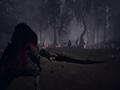
The setup is good enough, but don't expect much more elaboration until you get closer to the game's end. Even then, there's no grand narrative surrounding the adventure. The real hook comes from the premise itself: you're playing as and fighting against dinosaurs. They're actual four-legged dinosaurs wielding weapons in their mouths. Seeing your own dinosaur wield a sword is novel enough, but the bosses take the concept even further. A T-Rex wielding an ax is one thing, but seeing another use an ankylosaurus as a weapon before switching to a saw-toothed sword is something else entirely. Other enemies include a brontosaurus that uses a tree as a weapon and a triceratops equipped with a head-mounted flail. It's all both silly and cool, but the game deserves credit for never treating the concept as one big joke. Dinosaurs wielding swords are simply presented as a normal part of this world, allowing the premise to feel like something more substantial than a meme turned into a video game.
The game follows the core elements of the subgenre rather well. Stamina governs everything from attacking and dodging to blocking and parrying, but the drain isn't as severe as it is in other titles. You can perform more actions in succession before needing to step back and let your stamina recover, giving you more freedom to stay on the offensive before returning to the defensive. You have access to light and strong attacks, as well as charged attacks, and you can also unleash special attacks that consume mana. While there are no other items to manage, you can heal yourself using the equivalent of potions. Stone markers also function much like bonfires in other games, serving as both save points and places where you can fully replenish your resources.
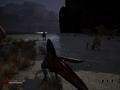
For a Souls-like, Dinoblade takes a more aggressive approach to combat, something further emphasized by a meter that serves as one of the game's biggest departures from the genre. The more you attack, the more the meter fills. Once it's full, a single well-timed block or parry allows you to unleash a counter that guarantees a hit and deals substantial damage. The catch is that the meter will gradually drain if you stop attacking, encouraging you to stay on the offensive rather than play as defensively as you might in most Souls-like titles.
The save system also differs quite a bit from those of its genre contemporaries. While most other games resurrect every enemy whenever you use a save stone, that is completely optional in Dinoblade. You can choose the Rest option to bring back every enemy, excluding bosses, or select Continue to fully replenish resources without respawning anyone. You also don't need to visit a save stone to level up your stats or change your equipment, further streamlining the process.
The weapons system is also different, primarily because you don't get a wide variety of weapons to use. You do get different swords, but that's all you'll have access to. Even though you'll encounter scythes, pitchforks, and other weapons throughout the world, you'll never be able to wield them yourself. The swords you can obtain don't differ in their stats, but they're still worth collecting because each one comes with a different ability, such as increased damage for strong attacks.
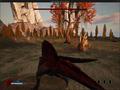
The game's lack of multiplayer also means that regular bosses and mini-bosses serve two additional purposes beyond being a source of substantial amounts of XP. First, bosses become summonable once you defeat them. They don't remain on the battlefield for very long, appearing only long enough to perform a single attack or combo, so they're more like special moves than actual companions. However, their attacks are unblockable, making them a reliable way to deal damage to another boss. Defeated bosses also provide buffs, much like the swords, including things like a larger parry window or reduced mana costs for summons. These buffs are more varied, however, thanks to the sheer number of bosses available.
The result is a game that aims to be more accessible without abandoning the qualities players enjoy about the genre. As mentioned earlier, the slower stamina drain lets you do more before needing to take a breather, while the combat itself feels solid, with plenty of weight behind each attack. That accessibility doesn't mean you can afford to get careless; even the weakest enemies can still kill you. The windups for attacks are easier to read, but the timing remains precise enough that recklessly spamming the block button will get you hurt more often than not. Enemies still have attacks that can't be interrupted, but they're rare, and you have plenty of opportunities to create openings. Boss arenas are also wide open, giving you plenty of room to maneuver, but you still need to pay attention to your surroundings to avoid getting stuck. The leveling system is more forgiving thanks to the abundance of XP available early on, allowing you to feel powerful fairly quickly, but some grinding may be necessary for the bosses in the game's back half. Overall, there's a good balance between the advantages given to you and those given to your enemies, making each fight feel inherently fair even when bosses can deal several times your damage with a single strike.
It does all of this in a world that is surprisingly easy to navigate despite the lack of a map or other guiding markers. Part of this is because some of the five available worlds use fairly linear layouts, but even the more open areas are designed in a way that naturally draws you toward the main boss. More importantly, every area gives you a reason to explore, whether you're finding enemies, secret upgrades, or bosses and weapons that you might otherwise miss. As a result, exploration and simply wandering around the world almost always feel worthwhile.
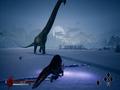
The campaign takes around eight hours on average, but that number depends on your skill level and how much you choose to grind in preparation for difficult boss fights. That's a decent length for most games but is considered quite short for a Souls-like. In this case, the shorter campaign works in the game's favor, as its simpler approach could potentially wear thin if the novelty of dinosaurs wielding weapons starts to fade. Beyond the campaign, there's also a boss rush mode that presents a genuine challenge since you can't heal between fights or re-spec your character separately from the build used in the main campaign. At least you're only required to fight four main bosses rather than every major and minor boss in succession, keeping the mode from becoming an outright endurance test.
Despite the game's general polish, there are a few bugs and minor issues to contend with. The camera can occasionally get blocked by objects, although this is rare. Fighting on cliffs can also lead to enemies suddenly appearing at a higher elevation than you. It's sometimes unclear whether you've toggled running on or off, and the upgrade menu can be frustrating when unlocking one item requires you to navigate away from the page before you can unlock another, even if you already have enough points. None of these issues are particularly serious, and they're easier to forgive when you consider the size of the development team, but they're still noticeable enough to cause occasional frustration.
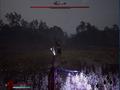
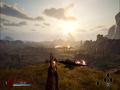
Graphically, Dinoblade is mostly fine. It's dominated by dark and dour colors, but there are moments of genuine beauty, such as when you first enter the green plains. The dinosaurs and environments look good, but some areas are less detailed than others and can come across as rather basic. The animations are generally easy to read, even if they lack some fluidity at times. There's also some item pop-in when viewing the world from a distance, but it isn't severe enough to put you at a disadvantage. In short, Dinoblade looks good without being a graphical showcase, particularly when some of the menus look basic and certain screens still have the appearance of debug environments rather than polished final versions.
Compared to the graphics, the audio hits on all fronts. The voice acting is limited to the one dinosaur that rescued you, and that's completely fine since having everyone speak would likely make the game lose some of its inherent charm. The performance from that one character is rather good, making the few lines delivered throughout the game a treat to hear. The sound effects are solid across the board, but it's the music that really leans into the game's sillier side. The title screen track sounds like something you'd hear during the opening sequence of a generic anime. As you wander through the environments, you'll hear music reminiscent of other Souls-like games, but the boss fights are where the soundtrack really stands out, with tracks that embrace a rock and metal vibe. It feels completely out of place, yet somehow makes the fights seem even cooler, so you'll quickly learn to roll with it, thematic clash be damned.
The game also runs mostly fine on Linux. Aside from a brief pause at the title screen while the world loads, you shouldn't have many issues running it on a desktop across most distros. On a Steam Deck, the game performs fairly well despite what the numbers might suggest. The frame rate can fluctuate wildly between 30fps and 60fps depending on what's happening on-screen, but the game remains responsive even during the busiest encounters. The resolution is lower than what you'd get on a desktop or laptop, but the drop in graphical fidelity isn't particularly noticeable, at least with the graphical settings the game defaults to on the Deck. Battery life averaged around 90 minutes on the Steam Deck LCD model, which seems to be becoming the norm for games running on the latest version of Unreal Engine.
Dinoblade is a good example of an absurd concept being done right. Once you get past the gimmick of dinosaurs wielding blades, you'll find a Souls-like that sticks closely to the genre's core principles while introducing enough quality-of-life changes to make the experience more approachable for newcomers. The mechanics are solid, the campaign lasts just long enough, and the presentation is good enough considering the game's very small development team. Unless you absolutely hate the genre, Dinoblade is well worth picking up if you want a Souls-like that doesn't require a high double-digit investment of hours.
Score: 8.0/10
More articles about Dinoblade