








Unless you're talking about a simulator-style game, any game that's set in a prison will try to make the backdrop feel like a more interesting version of a real-life facility. There will likely be loads of oddly designed passageways and a more elaborate security system. The game may even take you out of prison to advance the narrative and switch up the environment. Luna Abyss splits the difference, and that's not the only aspect that makes the title so fascinating.
The story takes place at an undetermined point in the future, when a red moon appears over Earth. Two hundred years later, the moon, now dubbed Luna, remains in the sky. After humans colonize the moon, it's eventually transformed into a lunar prison. You are its latest prisoner, mysteriously transported there and given the name Fawkes. Sentenced to more than 9,000 days, you must inhabit remote bodies to explore the moon and reduce your sentence. Under the orders of the warden, known as the All-Father, you'll undertake missions across Luna's depths and ruins, now overrun by a black substance called the Scourge. As you explore, you'll uncover the many mysteries of the red moon.
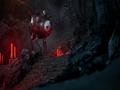
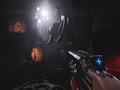
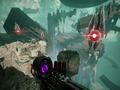
Luna Abyss' story immediately stands out for its sheer strangeness. The premise is already bizarre, but it's the small cast of characters you encounter that will make you question the game's sanity. Your prison guard, Aylin, is a giant robotic head attached to a long, snake-like neck that constantly stares at your bed. The elevator operator is another oversized robotic head that seems to enjoy moving the elevator up and down all day. Then there's Urien, a character with a cat's body and a hammer for a head who regularly helps you, even though you're eventually given the order to kill him in exchange for a significant reduction in your sentence. That's all within the first hour. You'll meet plenty more equally bizarre characters before the credits roll. Combined with moments when the game deliberately glitches, displaying seemingly random words in large red letters, the result is an experience that's as fascinating as it is downright strange.
The game uses a first-person perspective, which instantly makes you think that this is a shooter. While there is some shooting, it is far from being either a pure modern shooter or boomer shooter. The shooting is reminiscent of Tower of Guns or a first-person rendition of Returnal, since this is all "bullet hell" inspired. Just about every enemy is fond of throwing out multitudes of large orbs of various colors in various patterns. They can look cool, but it is a lot to deal with, since there are few instances when only one enemy is present, even during boss fights. What helps make this manageable is the aiming system, which ditches the aim down sights of most shooters in favor of a lock-on system reminiscent of the Metroid Prime series. Hold down a button, and you automatically latch on to the target closest to your reticle. You'll do so without any loss in movement, but you'll inadvertently change targets if you try to move with a normal shooter mentality during the lock-on phase.
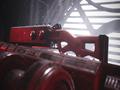
Lock-on makes combat more manageable, but it doesn't necessarily make it easy. Enemies take more than one shot to kill, and with the sheer number of foes and projectiles flying around during fights, you'll quickly appreciate the lock-on feature. The game removes the need to manage ammo and reloads but replaces them with a weapon cooldown system. You also have access to useful tools like a bubble shield and a dash, though the former keeps you stationary and the latter won't let you pass through enemy fire unscathed. As you progress, you'll acquire more powerful weapons, including a shotgun, rocket launcher, and sniper rifle. However, their primary use is to break through the colored shields some enemies carry before you switch back to your basic rifle. This might seem counterintuitive for a first-person shooter, but there's a good reason. Your healing options are limited to passing by large healing crystals or performing finishing moves on weakened enemies to recover health. As a result, playing strategically and relying on finishers is often more effective than constantly going in with guns blazing.
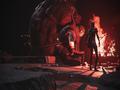
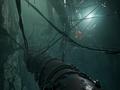

Despite this, Luna Abyss isn't just a pure bullet hell shooter. Most of your shooting is done in relatively enclosed spaces, and the combat is frantic, but it isn't constant. The rest of the game can be described as a first-person platforming adventure, as that is exactly what you'll be doing for large chunks of the game. You'll jump over gaps between platforms, navigate narrow pipes in dark areas to reach hidden alcoves, slide down inclines to reach small platforms, jump down large holes while avoiding rotating laser beams, and use your guns to open up passageways.
While you won't find anything crazy like wall-running or the like, you have some neat platforming tricks. Things like a double-jump are pretty normal, as is a slide, but the more exciting stuff comes from the game's version of a grappling hook. Instead of throwing out a physical hook, you'll possess various robots that can be used as leaping points. You can use their presence to elevate yourself to higher ground or phase through grates, in addition to other tricks.
The combination of these things creates an experience that features nothing new. There's nothing that feels like it hasn't been done in past games, especially with the lack of difficult puzzles, aside from hitting switches in time to open doors. It all works because the game feels so solidly put together. The world feels properly lived in, so you can feel the history behind it. The game's mix of linearity with a bit of backtracking doesn't feel odd because the flow of travel feels natural. It actually takes some work to get lost. Most fights can feel easy, but getting hit never feels cheap, as you're often made aware of when threats are coming your way. It all feels good, and the game's length ensures that the experience goes by at a good clip with a strong sense of progression.
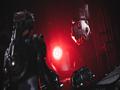
Graphically, Luna Abyss mixes in some beauty with its bleakness. You'll mostly be subject to dark hallways with pipes and other industrial-looking paraphernalia, some of which is covered in a bubble-looking goo that is the Scourge. You'll eventually be treated to big ornate rooms that look like they came from a European sci-fi comic, and you get a mix of that along with Japanese sci-fi anime and manga thanks to the robot designs with large creepy faces. All of this gets bathed in red, whether it's red lights or red trees or anything else crimson, but don't expect any sort of gore, even though you will see loads of bones and skeletons. The overall aesthetic is good enough, so even though you'll see some low-resolution textures if you stand close to something, it isn't bothersome. The game runs at a very high frame rate and doesn't tank when loads of particles are on-screen, but you will see some stuttering when new elements are introduced due to immediate shader compilation.
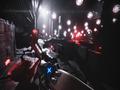
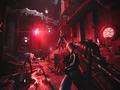
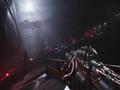
Meanwhile, the audio strengthens the overarching mood while adding some charm. The horror aspect comes from the music, which is filled with melodies that are brooding, especially when a vocal choir comes in. It's haunting stuff, but it isn't overwhelming because the music plays at a low enough volume to stay present but not be the focus. There are some tracks that bring in some high-energy action when it comes to fight sequences, but even those have an underlying sense of foreboding.
Voices provide a necessary contrast to the game. Everyone in the cast has their UK accents on full display, which gives the game some personality, especially for those who don't normally watch the likes of Doctor Who. Some of the characters contribute to the game's overall melancholy mood, especially when some of those characters have several voices mixed in together. Others are simply cheery in their situation and add some brief levity. This is especially true of Fawkes, who voices any of the selected dialogue choices.
The game has absolutely no issues running on a Linux PC. None of the graphical settings are blocked, and the overall performance remains high, but you need to keep in mind that the settings are saved in the cloud, so you will need to remember where every menu option is if you go between different screen resolutions and the game is only displaying a fraction of the screen. On the Steam Deck, the resolution issue isn't present, but don't expect to tweak any of the graphical settings, as those are gone on the device. Frame rate tries to hold steady at around the 40fps mark, but that can fluctuate wildly, but it's not enough to make the game unplayable. The game still looks quite good in this unknown preset, but don't expect anything beyond 90 minutes of playtime on a full charge.
Luna Abyss is an absolutely solid game if you're looking for an equal amount of first-person shooting and first-person adventuring. While the mechanics all feel familiar if you've played many first-person games in the past, the fact that the game remains well built while encouraging you to not stop playing is a testament to how good the title is. The game comes in at a good length, and while some players may not agree with the ending, the journey remains worthwhile. Luna Abyss came out of nowhere, but first-person fans will find it to be well worth discovering.
Score: 8.0/10

More articles about Luna Abyss