










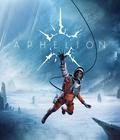
 Aphelion is a cinematic third-person sci-fi action/adventure that blends exploration, traversal, and tense stealth gameplay.
Don't Nod rarely does sci-fi. The developer started in the genre with Remember Me, but the success of Life is Strange meant it focused more on supernatural than scientific in the narrative adventure genre. Aphelion sees the developer continue with the narrative adventure while also returning to the sci-fi genre, a combination that works well for the most part.
By the year 2060, Earth is a mess, with rising waters and other calamities causing the planet to reach near-uninhabitable status. As the situation has become dire, a ninth planet named Persephone has been discovered. The ESA sends out two of its best astronauts to investigate whether the planet is suitable for human life, but the mission starts off badly. The craft experiences a crash landing, causing the duo to separate. You play as both astronauts, Ariane and Thomas, who try to reunite with one another while also proceeding with the mission to investigate the planet and its secrets to possibly secure a future for humanity.



Story has been a strong suit for Don't Nod, and Aphelion is no exception. The major trappings of a modern sci-fi story are all there, from the awe of finding someplace completely new to the threat of an alien life form that dislodges mankind from the top of the food chain. A surprise twist with undisclosed expeditions and corporate involvement also makes an appearance, and all of those things are balanced well against one another. The prevailing themes that make the story resonate have to do with relationships. The game starts off at the end of a conversation between Thomas and Ariane, and while it isn't explicitly said, you can tell that feelings are being brushed aside for the sake of the mission. As the story goes on, there's some regret happening alongside the loneliness and the inability to share any discoveries with someone who's been on the journey with you from the start. This aspect makes it a more human story with some sci-fi elements, and there's a prevailing sense of melancholy that works well with the rest of the tale.
Don't Nod's previous adventure games have been compared to Telltale titles in that they feel like walking simulators with some interactivity and an emphasis on choice. Aphelion is a bit different in that regard, and the most noticeable difference is the removal of choice. There are no branching paths. There are no grand decisions that need to be made that can potentially change the direction of the story. This is a completely linear adventure from start to finish, with a specific story to tell and one definitive outcome before the end credits roll. On the one hand, this avoids the trap that some adventure games fall into where choices don't matter as much, since the story will make some illogical leaps toward a predetermined solution. On the other hand, it also means that you have a game that has no need for a replay, since you've seen just about everything in one playthrough.
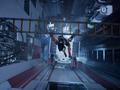
Aphelion has you playing as both astronauts, and their experiences are different in some fundamental ways. You start off with Ariane, who gets all of the game's major movement sections. It starts off in the downed ship where you'll have moments of sliding down a slope, and you need to ensure that you don't crash into something. You'll have climbing portions where you need to latch onto handholds. You also have a grappling hook that can be used to rappel up and down cliff walls or swing over large chasms. All of that movement helps you get through most of the environments on the planet, but the game also adds some different obstacles. You may be asked to traverse fragile ice fields and hope they don't break under your weight. You may try to shield yourself from cold, biting winds while using your spectral analyzer to manipulate rock formations multiple times. You'll be doing lots of action-packed stuff.

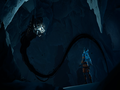
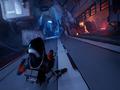
While she gets to do loads of non-combative action, Ariane also gets involved in the stealth sections, where you need to sneak around a creature that only reacts to sound and touch. The stealth isn't as in-depth as you'd find in other games where stealth is the main focus, so you're adhering to the basics, like not running or walking on water or taking big leaps and landing hard enough to make sounds. Later on, you can manipulate crystals to make noise for you for a short amount of time, but that's all you'll have at your disposal. The system is basic, but it works, and thankfully, the game doesn't make these sections last longer than necessary.
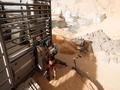
When playing as Thomas, you'll notice that his sections are less action-packed. The act of traversal differs greatly from Ariane's. Thomas can vault over low obstructions, but don't expect him to jump or do any climbing like Ariane. He has a grappling hook, but he uses it as a tool to pull down bridges and break open gates. His traversal is also hampered by the fact that he needs to be connected to oxygen stations throughout a good chunk of the playtime since his own tank is leaking. This creates some interesting scenarios where you have to plan your route carefully to ensure you reach the next oxygen tether spot.
Since his platforming abilities are so limited, your time with Thomas is going to be spent deep in investigation. Don't expect something as deep as the recently released Cthulhu: The Cosmic Abyss, however, as your investigation is limited to checking logs and notes and other oddities around a man-made base for a mission that was hidden from this two-person crew. This is exactly what you'd expect from the modern adventure game, but that isn't a slight, as investigation is a good way to flesh out the world.
The amount of time spent with each character feels equal, even though you'll spend more time playing as Ariane than Thomas. It helps that the characters have different enough skill sets that the experiences feel distinct without having to drastically change your play style when the character switches. The gameplay feels good overall, and with a runtime average of about eight hours, the game never feels like it's dragging along or padding the runtime.


As mentioned before, the decision to go with a linear story means that this will be a one-and-done game for most people. For completionists, however, the chapter menu that appears once you beat the game gives you a chance to go find any collectibles you may have missed. Getting the logs helps to flesh out the backstory, and finding the glyphs is neat, but they don't change up the story. For the achievement hunters, the chapter menu saves players from having to replay the whole game to get everything.
Aphelion exhibits some flaws, and some of them are pretty minor. There are moments when the appearance of a button prompt can be finicky. This can happen when trying to descend a rock wall or look at a document; you'll be in what you think is the correct position, only for the game to show the button prompt for a split second before removing it, forcing you to reposition in the hopes of making it reappear. The most annoying issue happens toward the end of the game, when you're up against the creature that you've been avoiding. You'll suddenly get automatic running sequences, and the timing for some of the actions has such a small window that you'll rely on luck to nail the timing. Another issue appears when control is taken away from you, but the creature attacks when they're not supposed to, resulting in a death you can't prevent. For a game that is relatively problem-free up until that point, it is disappointing to see these issues in the home stretch.
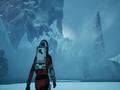
Graphically, the game has a more realistic look compared to most of the studio's previous titles. This is obvious in the faces of the main characters, which do a good job of conveying lots of emotions with simple details, like eyes darting around or tears trickling down cheeks. The textures on their skin and uniforms are also very well detailed, so you can even recognize the individual flags represented on their ESA badges. You can tell that most of the work was concentrated in this area, since the environments still look good but can get away with slightly lower detailed textures. The lighting and animations look quite impressive.


The audio is a real highlight. The voice work is excellent, with the main actors doing their best in conveying emotions from sadness to frustration to anger and everything in between. This also applies to the actors who only have roles within the voice logs; they also put in believable performances. The music is also excellent and used sparingly, so the environmental noises take over most of the time. When there is music, the tracks also convey the appropriate emotions and elevate the scenes.
Linux users will be happy to know that the game runs fine on that OS, but you'll want to use the latest version of Proton-GE to ensure that the opening movies play without any issues. Steam Deck users will want to do the same, while also tempering expectations of what the now-four-year-old device can do with a modern Unreal Engine-powered game. The game shares its settings over Steam Cloud, so you'll need to recalibrate things if you plan on going from PC to Steam Deck and back again. Letting the game auto-detect settings gives you a mix of low and medium options, but you'll need to change the FSR 3.1 settings yourself. Changing FSR settings helps with the battery life, as you can average around two hours on a full charge on the LCD version of the Deck, but it won't help change the frame rate. On average, you're looking at around 24fps on most scenes, which is mostly fine for a game like this. It's only problematic late in the game for the brief moments when you need faster reflexes. This is still playable, but stronger handhelds will certainly net you at least 30fps with the same settings.
Aphelion does well in both providing a good story with emotional pull, while also providing an experience that differs from the studio's previous works. The investigative portions may feel light, but they also provide a nice break from the stealth and climbing sections. The investigation, stealth, and climbing make the game feel more involved than what some may expect for a genre that can border on being walking simulators or Western versions of the visual novel. The presentation is great, and the runtime feels just right, making Aphelion an experience that's well worth checking out.
Score: 8.5/10

More articles about Aphelion